How to Cure and Store Garlic So It Keeps for Months
- How to Store Garlic: Cure It First, Then Keep It Cool, Dry, and Dark
- Step 1: Harvest at the Right Moment
- Step 2: Cure Garlic for Two to Four Weeks
- Step 3: Store Cured Garlic in a Cool, Dark, Ventilated Spot
- How Long Does Garlic Last? (By Type and Method)
- Is Garlic in Oil Safe? Read This Before You Make It
- Long-Term Options When the Harvest Is Big
- Quick Reference: The Whole Process at a Glance
How to Store Garlic: Cure It First, Then Keep It Cool, Dry, and Dark
The short version: garlic keeps for months when it is properly cured — dried for two to four weeks in a shaded, well-ventilated spot — and then stored at cool room temperature, in the dark, with air moving around the bulbs. A mesh bag in a pantry works beautifully. A refrigerator does not, and garlic submerged in oil on the counter is genuinely unsafe.
Everything below expands on that sentence: when to pull your bulbs, how to cure them so they seal themselves for storage, where to keep them, how long each type actually lasts, and what to do with a harvest that outruns your appetite.
If your garlic is still in the ground, start with our guide to growing garlic from clove to harvest — good storage begins with a healthy, mature bulb.
Step 1: Harvest at the Right Moment
Storage life is decided before you ever hang a bulb. Garlic pulled too early has small, soft cloves and papery wrappers that never fully form. Garlic pulled too late has split wrappers and exposed cloves — fine for eating soon, poor for keeping.
When to harvest garlic: dig when roughly the lower half of the leaves have turned brown and the upper leaves are still green. For most fall-planted garlic that means early to midsummer, though the exact week depends on your climate and when you planted — see when to plant garlic by zone for how timing shifts across regions.
Each green leaf corresponds to a layer of wrapper around the bulb. You want several intact layers left at harvest, because those wrappers are the packaging that protects the cloves for the next six months.
A few harvest habits that pay off at storage time:
- Loosen the soil with a fork and lift — never yank the stalk. A bruised or nicked bulb is the first one to rot in storage.
- Brush off loose soil gently. Don't wash the bulbs, and don't bang them together to knock dirt off.
- Keep them out of direct sun. Freshly dug garlic can scald in strong sunlight in under an hour. Move bulbs into shade as you dig.
- Set aside your biggest, best bulbs as seed stock if you plan to replant in fall. Big cloves grow big bulbs.
Step 2: Cure Garlic for Two to Four Weeks
Curing is the step most new growers skip, and it is the single biggest difference between garlic that lasts three weeks and garlic that lasts eight months.
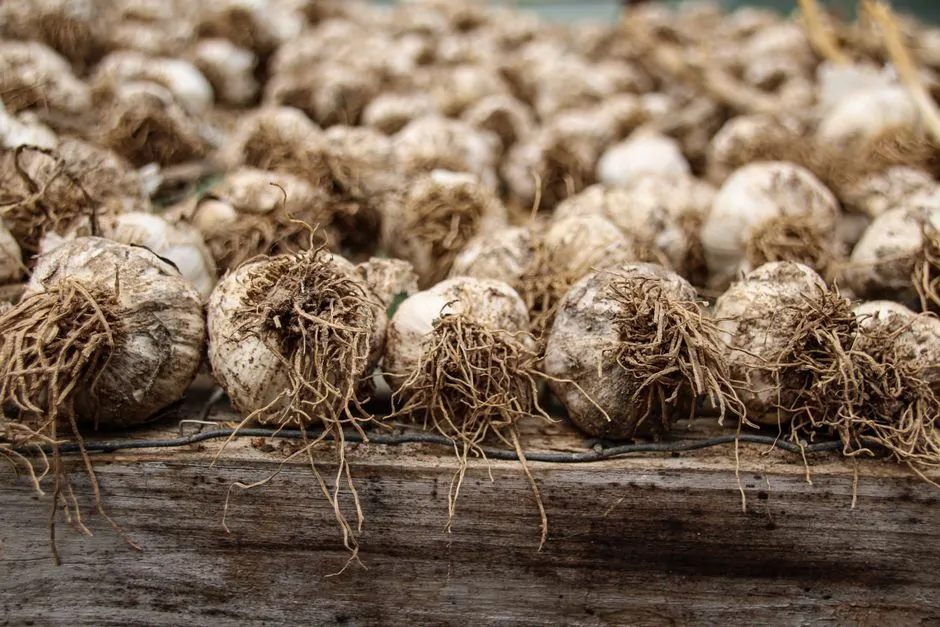
What curing is: curing garlic means letting the whole plant — bulb, stalk, and leaves — dry slowly for two to four weeks in a warm, shaded, well-ventilated place. As the plant dries, the neck seals shut, the outer wrappers turn dry and papery, and the cloves settle into a dormant, shelf-stable state.
How to set up a curing space
You need three things: shade, airflow, and dry warmth. That's it.
- Location: a covered porch, garage, garden shed, barn, or well-ventilated indoor room all work. Direct sun is the one hard no — it cooks the cloves.
- Temperature: ordinary warm-summer conditions, roughly 70–85°F, are ideal. Cooler works; it just takes longer.
- Airflow: this matters more than temperature. If your space is humid or still, a small fan on low, aimed across (not directly at) the garlic, speeds things dramatically.
- Arrangement: either hang the plants in bundles of five to ten, tied at the stalks, or lay them in a single layer on a wire rack, old window screen, or slatted table so air reaches all sides. Don't pile them.
Leave the stalks and leaves attached while curing. The bulb continues to draw energy from the drying tops, and the intact stalk helps the neck seal properly.
How to know when garlic is fully cured
Check at the two-week mark, but expect three to four weeks in humid climates. Cured garlic shows all of these signs:
- The outer wrappers are dry, tight, and papery — they rustle.
- The neck is completely dry with no green, moist core when you cut through it.
- The roots are dry and wiry.
Once cured, trim the roots to about a quarter inch and cut the stalk an inch or two above the bulb (softnecks destined for braiding keep their stalks — more on that below). Brush off the dirtiest outer wrapper if you like, but leave as many layers intact as possible.
Step 3: Store Cured Garlic in a Cool, Dark, Ventilated Spot
Here is the entire storage formula for whole, cured bulbs:
- Temperature: cool room temperature — roughly 55–65°F is the sweet spot, and ordinary pantry conditions up to about 70°F still work well.
- Light: dark, or close to it. Light encourages sprouting.
- Humidity: moderate — neither desert-dry (cloves dehydrate) nor damp (mold).
- Airflow: essential. Garlic in a sealed container suffocates and molds.
In practice, that means a mesh bag, open basket, paper bag with holes, or braid hung in a pantry, cellar, or cool cupboard. Check monthly and pull out anything soft or sprouting.
Do not refrigerate whole bulbs
The refrigerator is the most common storage mistake. Temperatures around 40°F mimic the winter chill that tells a garlic clove it's time to grow, so refrigerated bulbs sprout quickly once they come back to room temperature, and the cloves deteriorate faster. The fridge is for peeled or cut garlic — covered, and used within a week or so — not for your curing-shelf harvest.
How Long Does Garlic Last? (By Type and Method)
Cured garlic stored well lasts three to nine or more months, depending mostly on type. Softneck varieties are the marathon keepers; hardnecks trade storage life for scapes and cold-hardiness.
| Storage method | Softneck garlic | Hardneck garlic | Notes |
|---|---|---|---|
| Whole cured bulbs, cool pantry | 6–9+ months | 3–6 months | The default. Softnecks can reach toward a year in ideal conditions. |
| Whole bulbs, refrigerator | Not recommended | Not recommended | Triggers sprouting; shortens usable life. |
| Peeled cloves, refrigerator | About 1 week | About 1 week | Covered container. |
| Peeled or chopped, freezer | 6+ months | 6+ months | Texture softens; flavor holds. Great for cooking. |
| Garlic in oil, refrigerator only | A few days | A few days | Never at room temperature — see safety note below. |
An unbroken bulb keeps far longer than a broken one. Once you crack a head apart, use the loose cloves within a week or two — so break bulbs as you need them, not in advance.
Signs garlic has gone past its prime
Use or toss cloves that are soft or spongy, visibly shriveled inside the wrapper, moldy, or sharply green-sprouted through the tip. A small green sprout isn't dangerous — you can slice the clove and flick it out — but it signals the clove is spending its stored energy and won't keep much longer.
Is Garlic in Oil Safe? Read This Before You Make It
This is the one place garlic storage crosses into real food safety, so we'll be direct.
Garlic stored in oil at room temperature is not safe. Garlic is a low-acid vegetable that can carry Clostridium botulinum spores from the soil. Submerged in oil, those spores sit in exactly the oxygen-free environment they need to produce botulinum toxin — and the toxin gives no warning: no off smell, no off taste, no bubbling. Botulism is rare, but it is severe.
Established FDA and USDA guidance is consistent:
- Never leave homemade garlic-in-oil at room temperature.
- Refrigerate it immediately and use it within a few days.
- Commercial garlic-in-oil products are acidified or otherwise treated to prevent this — follow the label, and refrigerate after opening.
- Freezing is the safe long-hold alternative: blend garlic with oil and freeze it in small portions, thawing only what you'll use.
If you want that mellow, spoonable garlic flavor on hand, roasting whole heads and refrigerating (or freezing) the squeezed-out cloves is the safer — and frankly more delicious — route.
Long-Term Options When the Harvest Is Big
A good garlic year can leave you with more bulbs than a pantry can hold. Beyond the basic cool-and-dark method, these approaches all store garlic long term:
- Braiding (softnecks only). Softneck stalks stay pliable after curing, so you can braid a dozen bulbs into a strand and hang it somewhere cool and dark — functional storage that happens to be beautiful. Hardneck stalks dry stiff and woody and don't braid.
- Freezing. Peel cloves and freeze them whole, chopped, or puréed in small portions. Frozen garlic loses its raw crunch but cooks almost identically to fresh.
- Dehydrating. Slice cloves thin, dry them until brittle (a dehydrator or a very low oven), and store whole as chips or ground into your own garlic powder in an airtight jar.
- Pickling. Peeled cloves in a vinegar brine, refrigerated, keep for months and turn mild and snackable. The acidity is what makes this safe where plain oil is not.
Quick Reference: The Whole Process at a Glance
- Harvest when about half the leaves have browned; lift, don't pull, and keep bulbs shaded.
- Cure whole plants two to four weeks in a shaded, ventilated, warm spot until necks are fully dry.
- Trim roots and stalks; leave wrappers on.
- Store at cool room temperature in the dark with airflow — mesh bag, basket, or braid.
- Break bulbs only as needed; use opened heads within a couple of weeks.
- Refrigerate only peeled or cut garlic; refrigerate garlic-in-oil always, and use it within days.
Do those six things and a summer harvest will carry you deep into winter — with the best bulbs set aside to go back in the ground and start the whole cycle again.